What makes a drywall repair cost more?
One of the short reads on the advice page, and it has no prices in it. It walks through what moves a sheetrock repair quote up or down, so you can read a quote and see where the time goes. Every quote from a local drywall contractor comes down to the same few questions.
How big is the damage?
Size sets the method. A nail hole takes a dab of compound. Doorknob damage wants backing behind it. Past palm size, the damage is cut into a square and a new board piece fitted, and beyond a certain point the opening runs out to the studs so the new piece has framing to fasten to. Each step up adds material, coats and drying time. Measure before you call; "roughly as wide as a paperback" beats "medium".
Is it on the wall or the ceiling?
Ceiling work is slower. Board has to be held overhead while it's fastened, compound wants to sag, and sanding overhead is tiring and dusty. Ceilings are also more often textured, which adds a step. The same size of hole usually takes more time up there than on a wall.
Is anything still wet?
Water changes the whole job. Gypsum that's been soaked loses its strength and comes out, insulation above it may need replacing, and the open bay is left to dry before replacement board is hung. Whatever let the water in must be repaired first, whether that's a roof hit by hail or a bathroom upstairs, and that is a separate trade's bill. A firm, dry ring needing nothing more than a sealer coat is a far smaller job than a soft, sagging section. The page on repairing ceilings after a leak explains how to tell the two apart.
What texture has to be copied?
A smooth wall needs careful feathering. Orange peel and knockdown need spray equipment and test passes on scrap board. Skip trowel is done by hand and takes patience. Popcorn ceilings bring a testing question too, because older acoustic texture can contain asbestos. The more steps the texture takes, the more time it adds.
Is the damage on a corner?
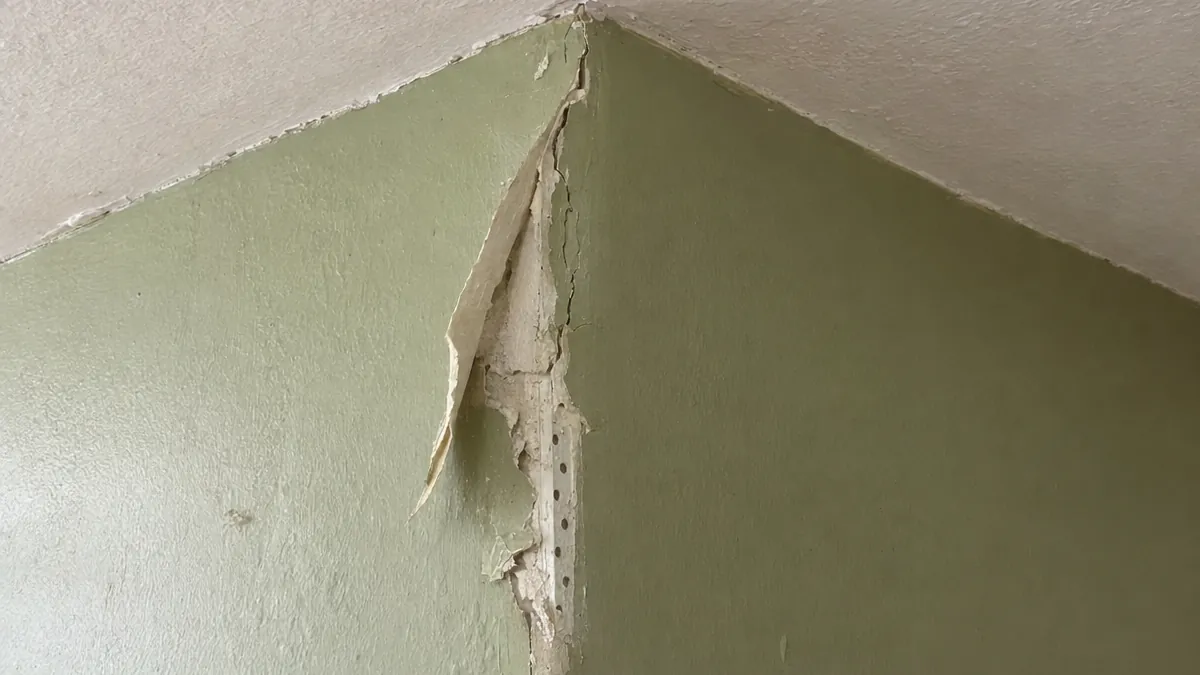
Outside corners get hit by dollies, vacuum heads and bed frames on moving day, like the corner pictured at the top. When the bead inside is bent, that section is removed and replacement bead goes on, coated on both faces. Corners need straight, sharp lines on two planes at once, so a short stretch of corner can take as long as a much larger flat patch.
How old is the house?
Age matters in Chadron. Per Census estimates, 884 of the town's 2,456 homes were standing by 1939, and the median year built is 1953. Older houses often mean plaster over lath, which is fastened back with washers and filled in layers instead of patched with board. Paint layers older than 1978 can hold lead, and lead-safe dust control adds setup time. Settled framing means cracks that need reinforcing, not just filling.
How hard is the spot to reach?
A hallway wall at chest height is easy. A stairwell ceiling, a vaulted room, or a wall behind a loaded bookcase is not. Ladders, planks, moving furniture and protecting floors all count. Clear the area yourself before the work date; it trims that part of the job.
Who is painting, and how much?
A quote can stop at primer, or include paint. Spot-painting a patch seldom blends, so a painted finish usually means the whole wall, edge to edge, and that adds time. If you have the leftover paint, keep the can; it saves guessing at color and gloss.
How many spots, and in which season?
Bundled into one booking, several repairs split the setup, cleanup and drying time, so list everything before you call: cracks, nail pops, dings and the hole behind the bedroom door. Season plays a part too. Mud and texture cure slower when the room is cold, and winters here are long, so a heated, ventilated room keeps the schedule tight.
Ready to price yours? Start with hole patching, crack and seam work or put your repair in the queue.
Know what it'll take now?
Want a figure? Call, or text over two pictures, one tight on the damage and one from the doorway.
A nearby drywall contractor rings next: a few questions, then a quote.